
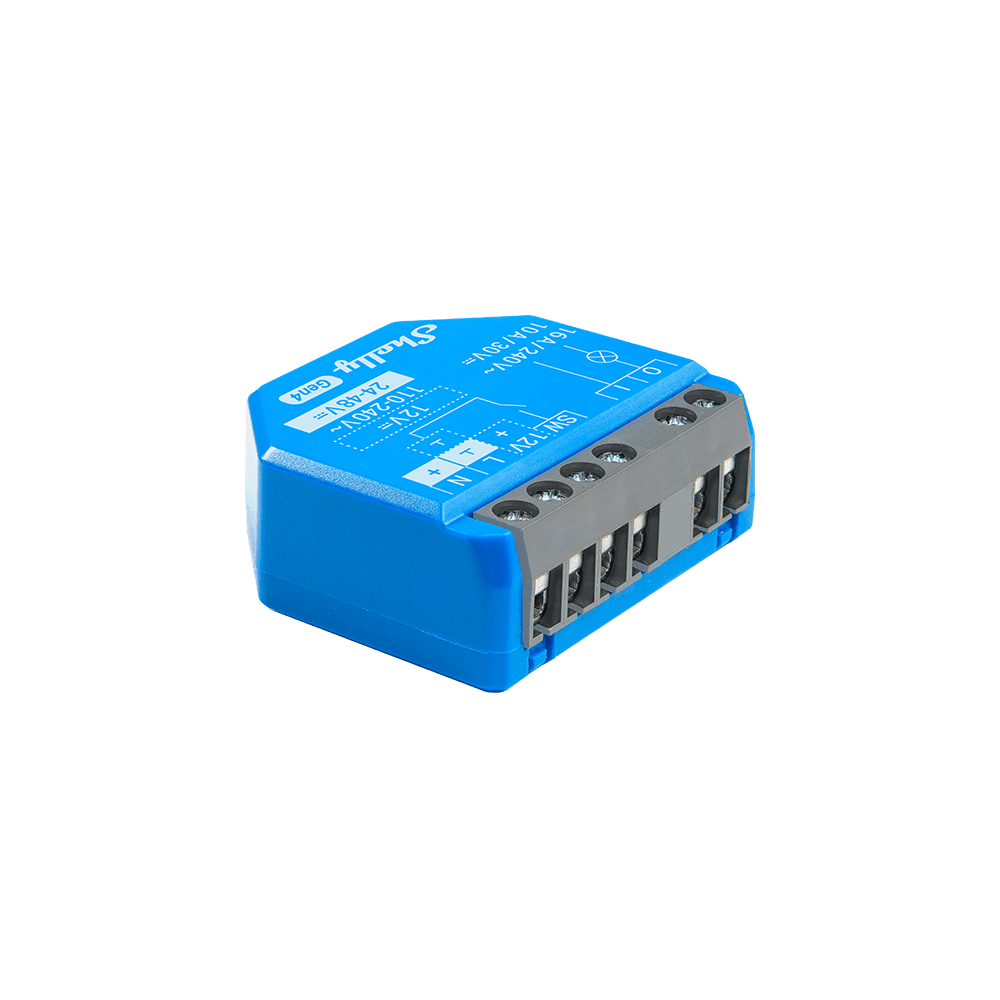
Shelly relays are small smart modules that can sit behind a switch, near a light fitting, or inside a suitable enclosure. For many homes, they are a neat way to add app control, schedules, scenes and automation without replacing every wall plate.
That is why they are popular in retrofits. If you like your current switches, have designer plates, or want to upgrade one room at a time, Shelly can be a sensible option.
What you notice as the homeowner
The benefit is not the little relay itself. The benefit is how the room behaves.
- The wall switch still works normally.
- Lights can join scenes such as Away, Movie, Night or Arrive Home.
- Selected circuits can be scheduled or automated.
- Some models can report power use.
- The home can stay familiar for guests and family members.
Good smart homes still need normal physical controls. Nobody should need to open an app just to turn on a hallway light.
Wired Shelly relays
Wired relays control the circuit directly. They are usually the better option when reliability matters and the wiring position is suitable.
Common uses include lighting, exhaust fans, garage triggers, selected pumps and other simple circuits, but only after the load rating and installation method are confirmed.
For you, the important question is simple: "Can this be installed cleanly and safely without making the wall ugly?" We check the switch box depth, neutral availability, heat, circuit type and Wi-Fi signal before recommending it.
Wireless Shelly buttons and controls
Wireless controls are useful when you want an extra button or scene trigger without chasing a new cable through a finished wall.
They can work well for:
- Bedside all-off scenes.
- Hallway scene buttons.
- Guest rooms.
- Retrofit homes where a new cable would be messy.
- Temporary controls during a staged renovation.
In a new build or major renovation, wired planning is still better for the important parts of the home. Wireless is excellent when it solves a real problem, not when it hides poor planning.
How Shelly fits with Home Assistant and bigger systems
Shelly can sit inside a wider smart-home design. A relay might control one lighting circuit while the home also uses wall panels, intercom, CCTV, smart blinds, climate control and Home Assistant-compatible logic.
The right question is not "Should everything be Shelly?" It is "Where does Shelly make this home simpler, cleaner and easier to maintain?"
What we check before recommending Shelly
Before we quote, we usually ask for switch photos, the room list and what you want each room to do.
Then we check:
- Whether the circuit has the right wiring.
- Whether there is enough space and ventilation.
- Whether the load is suitable for the relay.
- Whether the Wi-Fi signal is strong enough at the switch.
- Whether you want cloud control, local control, or both.
- Whether a full smart switch, panel or wired control system would be cleaner.
If your goal is a tidy retrofit, Shelly is often worth considering. If your goal is a high-end new build, Shelly may still have a place, but it should be part of a planned system rather than a collection of one-off fixes.